



Fitness 101: The Ultimate Five-Step Guide To Build Your Own Workout Plan
Step 3: Allocate Exercises

BOOYAH. By now your week should be organized into a workout split that’s designed to methodically blast each individual muscle group. That’s your cycle. Once that’s set, you’ll color in the lines with specific exercises and a rep/set protocol for each.
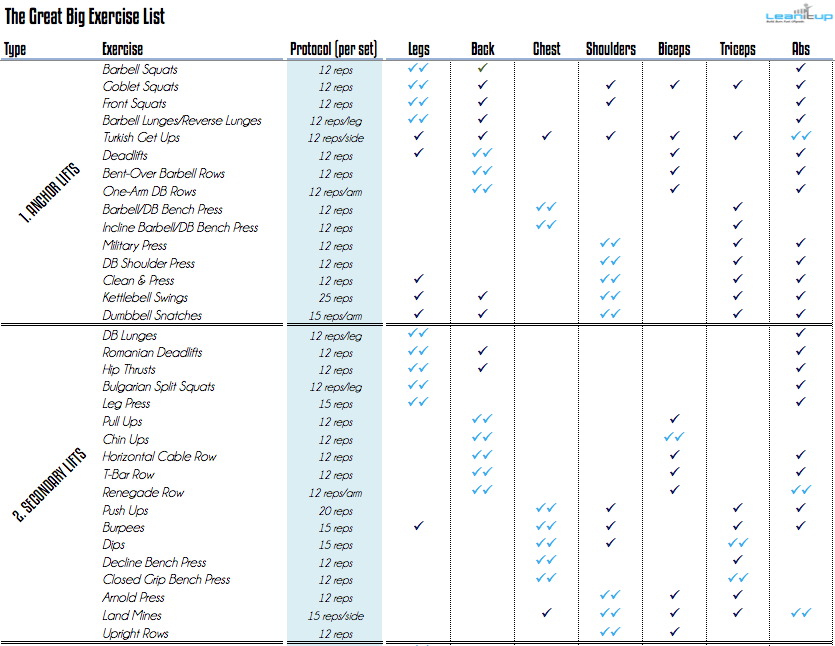
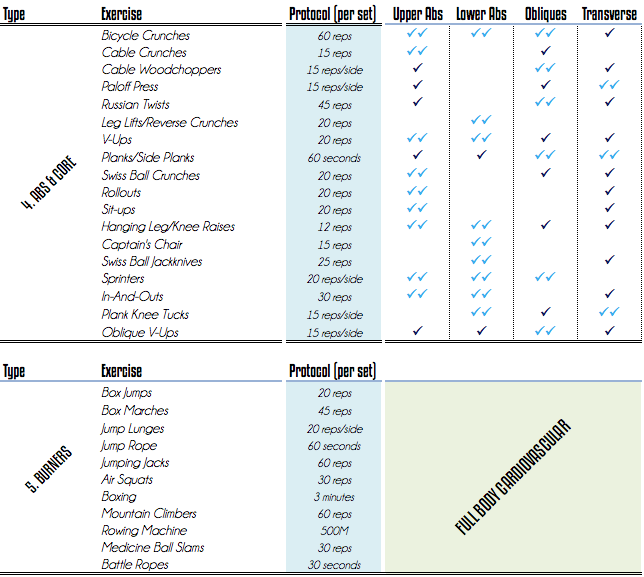
We’ve categorized exercises into 5 major groups: Anchor Lifts, Secondary Lifts, Isolation, Abs & Core, and Burners.
- ANCHOR LIFTS (e.g. squats, deadlifts) — BIG, compound exercises that serve as the foundation for all workout plans. They may not be super sexy, but they hit multiple different muscle groups, ignite metabolism, elevate heart rate, and build strength all at once. Consequently, they’re the most strenuous, but also the most foundational when it comes to muscle growth and sparking EPOC. Lean on ANCHORS when time is an issue.
- SECONDARY LIFTS (e.g. lunges, pull ups, push ups) — targeted lifts that hit multiple different muscle groups to a high degree. They’re not quite as intense or metabolic as ANCHORS, but they’re capable of efficiently blasting muscle fibers across the body.
- ISOLATION (e.g. biceps curls, triceps pulldowns) — “aesthetic” lifts that almost exclusively hit one individual muscle group. They’re slow, controlled, and low intensity. Isolation lifts are typically used in a bodybuilding capacity to accentuate individual muscles and carve out sharp cuts and delineation.
- ABS & CORE (e.g. bicycle crunches, planks) — self-explanatory. Use these to build a dedicated ab workout, or sprinkle them throughout a regular workout in superset fashion as a form of active recovery.
- BURNERS (e.g. rowing, box jumps, mountain climbers) — high-rep, endurance exercises that elevate heart rate, unleash sweat stores, and promote cardiovascular fitness. They’re a hybrid of cardio and resistance training. These work great as a warm-up or burnout set, or as a spoke in any metabolic training circuit.
To help simplify the workout building process, we’ve mapped out most of the exercises in the workout kingdom (use your imagination and extrapolate it out for similar variations).
Each move is broken down by A) exercise category and B) primary muscle groups targeted, including our recommended # of reps in a set of each. Remember — this is designed to spark general hypertrophy, aka muscle growth. Other rep ranges and protocols exist for strength, power, and endurance, but those are more advanced cases.
Think of it as an exercise bank that you’ll use to fill in the blanks.
As a general rule, an effective workout should last approximately 1 hour (obviously you can shorten/lengthen it to meet your own schedule). Roughly, that translates to 15-20 NON-AB sets per workout.
If we’re talking in terms of a math formula, that’s your SUM.
Depending on the length of your workout split, each individual workout should contain the following distribution of exercises (± a few sets, this isn’t exact science):
- TWO DAYS: 4 anchor lifts (x3) + 2 secondary lifts (x3), 1 burner (x2) = 20 sets
- THREE DAYS: 3 anchor lifts (x3), 2 secondary lifts (x3), 2 isolation (x2), 1 burner (x1) = 20 sets
- 4-6 DAYS: 2 anchor lifts (x3), 2 secondary lifts (x3), 3 isolation (x2), 1 burner (x2) = 20 sets
Visually, it breaks down in the following fashion:
And then for abs, whichever day they fall on, add an additional 10-12 sets from the ABS & CORE list. To save time and amp up the intensity, we recommend sprinkling ab exercises throughout one of your workouts as a form of active recovery.
For instance, you could do a set of planks in between each set of squats, or alternate bicycle crunches and deadlifts; almost as if it’s a superset.
Start matching. Pick your poison from the exercise chart above, line ’em up for the given number of sets, and voila, you’ve just built your very first weight-lifting circuit.
? TO-DO: Choose a smart balance of exercises—by body part—to fill in each day of your workout cycle. Fill out our printable blank template to construct a plan that makes sense for you.


